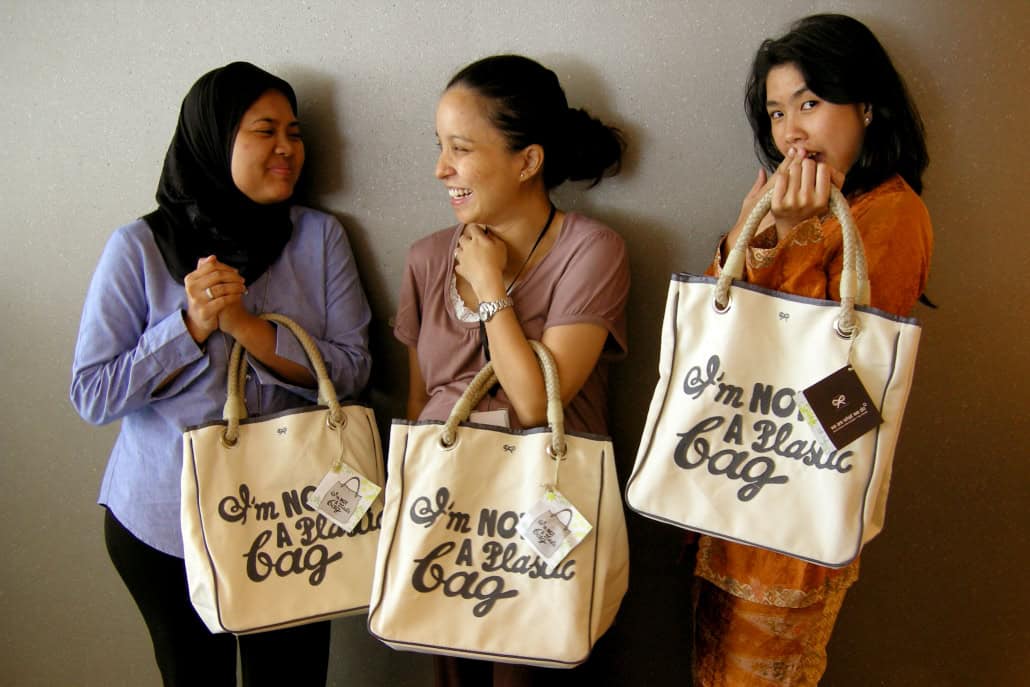
Phot credit Christie Chng
Alan R.P. Journet Ph.D.
Cofacilitator
Southern Oregon Climate Action Now
February 11th 2025
Testimony in support of SB551
Chair Sollman and members of the Senate Committee of Energy and Environment:
I write as cofacilitator of Southern Oregon Climate Action Now, an organization of some 2,000 Southern Oregonians who are concerned about the climate crisis and encourage state action to address it. As rural and coastal Southern Oregonians, we live on the frontlines of the warming, reducing snowpack, heatwaves, drought, rising sea level and the increasing wildfire risk that these trends conspire to impose on us. Because of this, we pay close attention to what is happening in the state legislature that relates to climate.
“Paper or Plastic?” Some of us may recall the frequent grocery store query from the check-out associate. In some states, this no longer happens since whether required or as a voluntary decision folks are turning to reusable bags. But is the provision of reusable plastic bags a good idea?
The first problem is that identified by Parker (2024): “Plastic pollution has become one of the most pressing environmental issues, as rapidly increasing production of disposable plastic products overwhelms the world’s ability to deal with them.” She points out that Asian and African nations have a problem since garbage collection is often either inefficient or nonexistent. Meanwhile, developed nations with low recycling rates have a problem. Indeed, she points out, plastic trash has become such a problem that there are effort through the United Nations to develop a global treaty. Frighteningly, half of all plastics have been manufactured in the last 20 years.
Invented/discovered in 1907 by Belgian chemist Leo Baekeland, Parker (2024) noted that plastics took off after World War II, with single use plastics accounting for 40% and this – leading to the throw-away society and half of all plastics being manufactured in the last 20 years. A recently recognized threat are microplastics, the product of plastic breakdown which are less than 1/5th of an inch across. These then break down into microfibers. Parker (2024) pointed out that “The tiny particles are in our blood, lungs, and even in feces.” This last comment referred to an earlier article by Parker (2018). Haederle (2025) reported that we have “microplastics in human brains, and at much higher concentrations than in other organs. Worse, the plastic accumulation appears to be growing over time, having increased by 50% over just the past eight years.” Besides their direct effect on humans, Parker (2024) noted that these plastics are a threat to both terrestrial and aquatic wildlife.
Sharo and Puebla (2024) reported on a federal government study (Karali et al. 2024) that suggested by 2050, at the current growth rate, the focus on plastics by oil companies as a means to replace losses from a diminishing need for petroleum products could account for 21-31% of greenhouse gas emissions. Referring to a report by Elbein (2024), they point out that: “Currently, the plastics industry is responsible for four times more greenhouse gas emissions than the airline industry, or about 600 coal-fired power plants.” Plastics are clearly a threat in terms of both human and wildlife health and the climate crisis.
Given the problem of disposable plastics, the encouragement to use reusable plastic bags seems promising. However, the problem becomes their actual reuse.
As Meiffren-Swango (2025) reminded us, The Oregon Legislature passed a ban on single use plastic bags in 2019, taking effect on January 1, 2020. That bill also demanded that single use paper bags handed out should require a 5-cent fee. A result of this rule, she further notes, has been that stores have turned to thicker reusable bags that can be used over 100 times. Unfortunately, few customers reuse these bags but simply toss them in the trash.
Hines (2024) describes the essence of the reusable plastic bag problem: “When plastics make it to a landfill, they do not biodegrade, but can leach toxic chemicals into the ground, damaging our soil quality and contaminating our groundwater. The plastic bags that don’t get to a landfill often end up littering the environment. As plastic breaks down in the environment, it breaks into smaller pieces called microplastics. Microplastics are now found nearly everywhere, from the top of Mt. Everest to the bottom of the Mariana Trench and even inside our bodies.” And “We found that despite plastic bag producers’ advertising that their bags are reusable, few customers seem to be reusing these plastic bags at grocery stores.” Indeed, in a study of 13 stores in 6 California cities, the researchers concluded that only about 2% of customers apparently carried reusable plastic bags into stores.
Hunt (2023) offered that “The battle against the single-use plastic bag may not be won but it’s definitely under way.” We are eliminating the thin plastic bags that float into the trees, she notes. The problem with the reusable bags, however, is that stores give them away and they aren’t reused. Indeed, she argues that because of the environmental footprint of reusable bags, they have to be reused 7,100 times to make them better than the conventional single-use plastic bag. Because of the overload and oversupply of the heavier bags, she concludes that the plan: “whereby a heavier bag is offered to encourage reuse, is simply not working.” Expecting customers to reuse a bag 7,000 times may be overly optimistic, but this equation illustrates the absurdity of retaining these bags as an option for store, restaurants etc.
The outcome of this exploration of the evidence suggests that the supply of heavy-duty reusable plastic bags is too large, and shoppers are simply not reusing them with sufficient frequency. Clearly, an educational program is in order. However, in the meantime, the best approach seems to be to prevent retailers from handing out such bags since to do so creates the false impression in the buyer that these bags are environmentally benign, free and readily available rather than in need of reuse. For these reasons, we support SB551.
Respectfully Submitted
Alan Journet Ph.D.
7113 Griffin Lane
Jacksonville
OR 97530-4182
[email protected]
541-500-2331
541-301-4107
Endorsement:

Isabella Lee Tibbetts, Chair, Jackson County Democratic Party
Environment and Sustainability Caucus
Source Cited:
Elbein S. 2024. Plastics industry heats world 4 times as much as air travel, report finds. The Hill. https://thehill.com/policy/energy-environment/4601309-plastics-industry-heats-world-four-times-as-much-as-air-travel-report-finds/
Haederle M. 2025 UNM Researchers Find Alarmingly High Levels of Microplastics in Human Brains – and Concentrations are Growing Over Time. UNM Health Sciences Newsroom. https://hsc.unm.edu/news/2025/02/hsc-newsroom-post-microplastics-human-brains.html#:~:text=Now%2C%20University%20of%20New%20Mexico,just%20the%20past%20eight%20years.