
2021 – 2023
A Closer Look
Legislative Record: 2021–2023
This page provides a detailed record of SOCAN’s engagement in Oregon’s legislative process during the 2021, 2022, and 2023 sessions. It compiles the bills we tracked, the official language of those measures, and the positions SOCAN adopted at the time.
In addition to these bill-specific materials, you’ll also find links to the end-of-year summaries that place individual measures within the broader legislative context. The aim is to create a clear, accessible archive of SOCAN’s advocacy record across these three years.
2023 Oregon Legislative Session
On June 25th, the Oregon Legislative session closed, as dictated by the constitution – no extensions possible. As those following the legislature will know, this session was again marred by the minority party in the Senate deciding to thwart discussion, amendment and passage in the Senate, of tens, if not hundreds, of bills. Ballot Measure 113 (passed in 2022) requiring that legislators taking ten or more unexcused absences would be ineligible for re-election did not have the desired effect. This measure passed by a thumping majority across the state; but the minority party didn’t get the message. They plan to challenge it in court
As a result of the walk-out, many critical bills were threatened. As a result, the majority party members produced a series of packages representing sets of critical bills that has been approved by the Joint Ways and Means Committee and thus were eligible to go directly to the Senate floor for a vote. The vote finally occurred in the Senate on Saturday 14th .
Where both HB3409 and HB3630 passed, largely on party line votes. One oddity was that HB3409 had been amended in the Senate Rules committee and this was the version that passed. As a result, the amended version had to go back to receive concurrence from the House. That house then suspended rules and concurred with the Senate version. So, both bills are on their way to the Governor for signature.
The packages were: HB3409 & HB3630
TOP PRIORITY Bills included in HB 3409:
- Resilient, Efficient Buildings Package (SB 868, 869, 870, 871)
- Community Resilience Hubs (HB 2990)
- Natural Climate Solutions (SB 530)
- Climate Action Modernization (SB 522)
- Community Green Infrastructure Act AKA TREES Act (HB 3016)
- Climate Protection Program Fee Bill (HB 3196)
- Medium and Heavy-Duty EV Incentives (HB 2714)
- Renewable Energy Siting (HB 3181)
- Harmful Algal Blooms (HB 2647)
- Woody Biomass for Low-Carbon Fuels (HB 3590)
Bills included in HB 3630:
- Environmental Justice and Tribal Navigator (SB 852)
- ODOE One Stop Shop (Resilient, Efficient Buildings) (HB 3166)
- State Energy Strategy and Resilience Planning (HB 2534 & 3378)
- Solar + Storage Rebate Program Extension (HB 3418)
- Residential Heat Pump Program Extension (HB 3056)
- Community Renewable Energy Grant Program (HB 2021, 2021)
We are somewhat disturbed by the inclusion of HB3590 in HB3409, but felt this concern was insufficient to negate the package. Thus, we report this outcome enthusiastically.
Inference:
The minority party in Oregon has long claimed to represent rural Oregon against the excesses of the majority party. The 2023 session represents the year after which this claim becomes no longer credible. The reasoning is as follows: Rural Oregonians live on the frontlines of the climate crisis and desperately need the state to assist in both adaptation to the inevitable climate change that is happening and will happen and mitigation to reduce the impact. We appreciate that the majority party has addressed the needs of rural Oregonians over the resistance and objections of the minority party.
Southern Oregon Climate Action Now has annually followed bills introduced to the Oregon Legislature that relate to climate. This year, some 4,000 proposals are expected. We are currently exploring those that have been filed to date and deciding which to promote and which to oppose.
Many of us will be following bills and giving testimony on those we wish to see passed or rejected. The best way to keep track of bills is via the Oregon Legislative Information System (OLIS). For a brief introduction to OLIS visit What’s an OLIS?
For tips on contributing oral and written testimony visit Testimony Tips.
Link to SOCAN’s Legislative Priorities
SB80 Cleaning up SB762 wildfire issues and the wildfire risk maps. Recommended Do pass with amendments and requesting referral to Ways and Means. (as A-Engrossed.)
SB 85-1 was HB2667, The Factory Farm (Confined Animal Feedlot Operation – CAFO – moratorium) bill was pulled from the House Committee agenda and assigned as -1 amendment to SB85 before the Senate Committee on Natural Resources since the expectation was that it would not be successful in the assigned House committee. This Factory Farm Moratorium Bill Prohibits Department of Environmental Quality and State Department of Agriculture from issuing or renewing license or permit to allow construction or operation of new industrial confined animal feeding operation, addition to or expansion of existing industrial confined animal feeding operation or addition to or expansion of livestock farm that would cause livestock farm to become industrial confined animal feeding operation. The -3 amendment restricts moratorium to poultry – we oppose this since poultry represent a minuscule component of the CAFO problem statewide. The -4 amendment is also weaker than -1 so we have maintained our support for -1 while acknowledging that -4 would be better than nothing. Hudson, Dembrow, Golden Assigned to House Committee On Agriculture, Land Use, Natural Resources, and Water; Ken Helm, Chair; text Public Hearing Held, SOCAN Testimony submitted Committee outcome: ”Without recommendation as to passage and request referral to Rules.” Since the Rules committees are not bound by the date deadline that constrains the policy committees, this keeps the proposal alive. Rules committee Public Hearing was held where we submitted written testimony and testified orally. At 45 seconds, this was the shortest testimony I have given this session.
SB522 Changes name of “Oregon Global Warming Commission” to “Oregon Climate Action Commission.” Modifies membership and duties of commission. Adjusts agency reporting; GHG reduction goal to 80% below 1990 by 2050. Senate Committee on Energy and Environment, 1:00 pm February 22nd SOCAN Testimony submitted Recommended ‘Do pass’ with amendments and referred to Ways and Means. (As A-Engrossed.).
SB530, the Natural Climate Solutions Bill promotes carbon sequestration in the state’s natural and working lands as a way to enhance the state’s effort to address the climate crisis. From the Intergovernmental Panel on Climate Change, it is clear that we must not only reduce emissions but also removes some of the greenhouse gases already emitted. Forestry that sequesters carbon and regenerative agriculture that promotes healthy soils are two ways to achieve this goal. SOCAN testimony on SB530. Recommended Do pass with amendments. Referred to Ways and Means. (As A-Engrossed).
SB530 Background:
As the years of its operation revealed that Oregon’s 2007 purely voluntary greenhouse gas emissions reduction program was failing to achieve its trajectory and interim goals, years of effort were spent developing a meaningful state greenhouse gas emissions reduction bill. In 2020, SB1530 was set to pass both chambers until Republicans staged a walk-out defeating the quorum in both chambers and thwarting passage of this and many other important bills. As a result of Republican refusal to engage in serious discussions about a climate program in Oregon, in March 2020 Governor Brown signed, Executive Order 20-04 This EO charged state agencies to develop programs within their authority to reduce greenhouse gas emissions across the state with a goal of achieving reduction of 80% below 1990 emissions by 2050. That EO also encouraged carbon sequestration in our natural and working lands and charged agencies to develop programs that incorporated equity. In response the Oregon Global Warming Commission (OGWC) developed a report that identified carbon sequestration in our natural and working lands as a state goal. During the 2022 legislative short session, SB 1534 was introduced to further the proposed OGWC sequestration target. This bill sought, among other related goals, to establish carbon sequestration as a state goal and develop a baseline assessment of historic sequestration. The bill was recommended DO PASS by the Senate Committee on Natural Resources and Wildfire Recovery but was awaiting Joint Ways and Means consideration when the session ended. This bill represents a 2023 effort to revisit the goals of SB1534 and take the action a little further.
SB530 Summary
Establishes promoting natural climate solutions as an Oregon policy in efforts to mitigate future climate change. These are activities that enhance or protect the ability of natural and working lands to sequester and store carbon or reduce greenhouse gas emissions, while maintaining or increasing climate resilience, human well-being and biodiversity. The bill also invests in research to improve understanding of the effects of natural climate solutions in the lands and the products from those lands as well as the contributions such solutions can make to reducing GHG emissions and increasing net carbon sequestration and strengthening climate resilience.
State agencies shall seek federal and private funding, incentivize and implement natural climate solutions, prioritize existing programs to administer funds, promote equity, ensure diversity among participants, identify resources to provide incentives, strengthen land manager education, engagement, and technical assistance, provide financial assistance to tribal, local governments, and NGOs.
The bill seeks to optimize social, health, ecological, climate resilience and economic benefits of natural climate solutions, through reducing Heat Island Effects, improving air quality, flood control, soil health and productivity, wildfire resilience and community protection, drought resilience and response, wetland and riparian functionality for enhanced water quality and quantity, and increasing long-term fiber supplies, climate resilience of fish and wildlife, and protection for coastal communities from the impacts of storm surge. It directs state agencies to incorporate natural climate solutions into their missions, programmatic investments and performance metrics and use metrics designed to track progress in implementing natural climate solutions.
It establishes a Natural and Working Lands Fund in the State Treasury, separate and distinct from the General Fund. Funds are then disbursed to Agriculture, Forestry, Watershed and Fish and Wildlife Natural Climate Solutions Funds.
See also Guest Column in Rogue Valley Times: NATURAL CLIMATE SOLUTIONS BENEFIT RURAL OREGON
SB542 Requires original equipment manufacturer to make available to owner of consumer electronic equipment or independent repair provider on fair and reasonable terms any documentation, tool, part or other device or implement that original equipment manufacturer makes available to authorized repair provider for purpose of diagnosing, maintaining or repairing consumer electronic equipment. Recommended Do pass with amendments. (As A-Engrossed.) Sent to Rules.
SB543 bans the use of expanded polystyrene (Styrofoam) containers in Oregon restaurants and for packaging. SOCAN testimony on SB543. Passed Senate and sent to House. Passed Senate 20:9 on 04/03; Passed House 40:18 on 04/26. Awaiting Governor’s signature. A VICTORY
SB545 Directs Oregon Health Authority to adopt rules allowing restaurants to allow consumers to fill consumer-owned containers with food. Passed Senate chamber 19:8, forwarded to House. Passed Senate chamber 19:8 on 3/15, forwarded to House. Passed House 39:17 on 04/26. Awaiting Governor’s signature. A VICTORY
Resilient Buildings Package of 4SB868-1 Healthy heating and cooling for all bill. Passed by Senate Committee on Energy and Environment and forwarded to Joint Committee on Ways and Means. SOCAN testimony submitted. Recommended Do pass with amendments and referred to Ways and Means as A-Engrossed.
SB869 – 1 Building smart from the start. Passed by Senate Committee on Energy and Environment and forwarded to Joint Committee on Ways and Means. SOCAN testimony submitted Recommended Do pass with amendments and referred to Ways and Means as A-Engrossed.
SB870 -1 Building performance standard. Passed by Senate Committee on Energy and Environment and forwarded to Joint Committee on Ways and Means. SOCAN testimony submitted Recommended Do pass with amendments and referred to Ways and Means as A-Engrossed.
SB871 -1 Smart State Buildings. Passed by Senate Committee on Energy and Environment and forwarded to Joint Committee on Ways and Means. SOCAN testimony submitted Recommended Do pass with amendments and referred to Ways and Means as A-Engrossed.
SB-5506 The Joint Committee on Ways and Means is holding public hearings around the state on the budget proposal. Closest to us will be in Roseburg at the Community College on April 21st 5:00 – 7:00pm. Local Earth Day events are happening on this day at the SOU Farm). Written testimony can be submitted urging funding for climate action generally or specific bills. Climate does not seem to have as high a priority as it deserves, which is inappropriate if the state genuinely wishes to contribute its share to greenhouse gas emissions reduction and sequestration. SOCAN Testimony submitted.
HB-2571 Directs Department of Environmental Quality to establish program for providing rebates to qualifying individuals who purchase electric assisted bicycles Recommended ‘Do Pass’ by House Committee on Climate, Energy and Environment. Referred to Ways and Means.
HB-2613 Appropriates $30,000,000 to Department of Environmental Quality for deposit in Zero-Emission Incentive Fund. Joint Committee On Transportation; Public Hearing April 6th Work Session 04/25. Recommended ‘Do Pass’ and referred to Ways & Means.
HB-2990 Resilience Hubs are Community Centers that provide shelter from disasters – such as earthquakes, heat, and wildfire, and provide information on how to survive the disaster. They often include off-grid power (e.g., solar panels, batteries, and generators). Assigned to Climate, Energy & Environment Pam Marsh Chair; Text Public Hearing and Work Session scheduled SOCAN Testimony submitted Recommended Do pass with amendments, as A-Engrossed, and referred to Ways and Means.
HB2998, the Healthy Soils Bill Creates the Oregon Soil Health Initiative to improve soil health in this state by collaborating on, and advancing, voluntary incentive-based soil health strategies such as sequestering carbon, building soil organic matter, improving water quality by reducing soil erosion, soil compaction while reducing agricultural production costs, promoting the beneficial activity of microbes, fungi, earthworms and other organisms and reducing the costs of agricultural inputs and protecting worker health. The program will be developed and administered by the Institute for Natural Resources at Oregon State University, The Oregon Department of Agriculture will support the initiative by collaborating with other agencies such as the Oregon Watershed Enhancement Board (OWEB), Natural Resources Conservation Service (NRCS). OWEB will provide grants for continuing or expanding initiative practices. OSU Department of Agriculture shall assess and track soil health. $480,000 is appropriated to Oregon Department of Agriculture, $2,480,000 to OWEB for providing grants and $425,000 to the Institute for Natural Resources. SOCAN Testimony on HB2998. Recommended Do pass with amendments and be referred to Ways and Means.
HB3003 Provides tax breaks for electricity utilities burning biomass that is at least 50% juniper.SOCAN testimony submitted urging amendment Forwarded without recommendation as to passage and be referred to Tax Expenditures by prior reference. A Public Hearing was held on this on 04/21 but I missed submitting testimony. So, I sent testimony to all committee members individually. Jeff Golden picked up on one of my comments responding to a proposed amendment reducing the requirement that juniper should be 50% of the biomass burned to 30%. I suggested that this would provide the perverse incentive of encouraging the logging of standing trees. I suggested an amendment to limit any tax breaks to the percentage of biomass combusted in a power plant that is actually juniper. Jeff Golden indicated he would introduce such an amendment.
HB3056 extends residential Heat Pump Fund until January 2, 2026.
This is a simple bill that does just this. Because electric heat pumps are by far the most efficient and effective means for both warming and cooling homes, SOCAN supports the principle of incentivizing the installation of these devices. It would be preferable if the bill limited incentives to electric heat pumps and excluded gas heat pumps. Recommended Do Pass, forwarded to Ways and Means.
HB3113 appropriates moneys from General Fund to Department of Transportation, for biennium beginning July 1, 2023, for improving safety and increasing access to walking, biking and transit on state highways that serve as community main streets. Joint Committee on Transportation. Public Hearing held.
HB3166 Requires State Department of Energy, in consultation with Housing and Community Services Department, to establish whole-home energy savings program and high-efficiency electric home rebate program. SOCAN Testimony submitted. Recommended ‘Do pass’ with amendments and be referred to Ways and Means.
HB3196 Authorizes Environmental Quality Commission to establish by rule fee to be paid by community climate investment entities. This encodes into statute the Climate Protection Program Community Climate Investment Fund. SOCAN Testimony submitted. Recommended Do pass and be referred to Ways and Means.
HB3229 Modifies federal operating permit program fees. Without recommendation as to passage and be referred to Ways and Means.
HB3464 Provides, for purposes of certain statutes relating to taking of predatory animals, that terms “predatory animal” and “rodent” do not include beavers. Alan testimony submitted Recommended ‘Do Pass.’ Passed House 34:11. Referred to Senate Committee on Natural Resources’. Hearing
HB3579 Clean Technology Leadership Bill; Requires Oregon Department of Administrative Services to adopt rules to promote clean energy technology in Oregon SOCAN testimony submitted. Recommended ‘Do pass’ with amendments and referred to Ways and Means.
HB-3590 Directs College of Forestry at Oregon State University, in collaboration with Department of Environmental Quality and State Forestry Department, to research development of fuel pathways for low carbon fuels derived from woody biomass residues from forestry operations. Recommended Do Pass and referred to Ways and Means. SOCAN testimony submitted Suggest neutral but oppose assumption that woody biomass is a positive option. Recommended Do pass and referred to Ways and Means.
HB5018 Appropriates moneys from General Fund to Department of Environmental Quality for certain biennial expenses. Joint Committee on Ways and Means, Sub-committee on Natural Resources. SOCAN testimony submitted. Seems to have died for lack of a Work Session
SB247 undoes provisions adopted in Senate Bill 762 (2021). Dead A VICTORY
SB251 Creates income tax credit for energy production in Oregon. Robinson. This insane anti-Oregon nonsensical bill would provide tax break incentives to all forms of energy thus promoting global warming and the climate crisis. No Public Hearing or Work Session – Dead. A VICTORY
[NOTE SB762 was based on recommendations from the bi-partisan Governor’s Wildfire Council report developed in response to the disastrous 2020 wildfire year. Some Oregonians and their legislators oppose provisions of SB762 based on misunderstanding fed by misinformation and disinformation regarding fire ecology principles. These bills are designed to undermine the bi-partisan effort of the Governor’s Wildfire Council].
SB647 prevents local governments from prohibiting natural gas use in or availability for new or existing residential or commercial buildings.
Buildings are responsible for some 40% of U.S. greenhouse gas emissions. Contributors to this value include the emissions resulting from the so-called embodied energy of construction, along with the day-to-day operations of buildings. The former results in so-called embodied carbon emissions while latter includes the direct day-to-day operational use of fossil (natural) gas and electricity generated from coal, oil or gas-fired power plants. No Hearings – Dead. A VICTORY
SB795 directs State Board of Forestry to convey certain state forest lands to county that determines that county would secure greatest permanent value of lands to county and requests conveyance. SOCAN testimony Submitted No Work Session – dead A VICTORY
HB2195 prohibits municipality that administers and enforces building inspection program from adopting construction standards or methods from Reach Code, or similar or related code of standards and methods, that exceed or are more stringent than statewide standards and methods [that the] Director of Department of Consumer and Business Services adopts and administers.
The whole idea of so-called ‘Reach Code’ in construction is to provide a set of standards that are more rigorous in some way than the standard state building codes. Her is yet another example f legislators bit undermining the ability of local jurisdictions of establishing rule appropriate for their community and that address major issues such as the climate crisis or wildfire protection. No Hearings – Dead. A VICTORY
HB2236 prohibits Governor and specified state agencies from taking measures to reduce greenhouse gas emissions in Oregon unless authorized by Legislative Assembly by law enacted on or after effective date of Act.
The climate science deniers frequently offer proposals that they argue do not reflect denial of the science, but reflect concerns about due process, or fairness, or something. But, they never offer a proposal that actually would, in any way, address the climate crisis. Here’s another example of climate science denial at work. Referred to Rules. WATCH
HB2587 undoes provisions adopted in Senate Bill 762 (2021). No Hearings – Dead. A VICTORY
HB2685 Restores availability of income or corporate excise tax credit for processing or collection of woody biomass. This bill would provide a tax credit for those using biomass as a source of energy. Although promoted as a means of encouraging wildfire protection by removing woody debris from forests, it could also promote logging which compromises forest health and results both in greenhouse gas emissions from the harvest itself and precludes further sequestration of carbon from the standing trees. SOCAN testimony on HB2685. Referred to Joint Committee on Tax Expenditures; no Hearing scheduled. WATCH
HB3022 prohibits Environmental Quality Commission and Department of Environmental Quality from adopting or enforcing rules or standards related to motor vehicle fuels or emissions unless authorized by Legislative Assembly by law enacted on or after effective date of Act. Another legislative proposal that simply undermines the ability of a state agency to perform its duly assigned and authorized responsibilities under the guise of ‘defending democracy.’ In this case, the proposal would precent the DEQ from reducing greenhouse gas emissions from the economic sector responsible for the largest percentage of Oregon’s regulated greenhouse gases. SOCAN testimony on HB3022. No Work Session scheduled – Dead. A VICTORY
HB3382 Authorizes certain ports to construct, maintain and improve deep draft navigation channel improvements without demonstrating compliance with state or local land use law. Joint Committee on Transportation. Public Hearing held; no Work Session schedule.
HB-3590 Directs College of Forestry at Oregon State University, in collaboration with Department of Environmental Quality and State Forestry Department, to research development of fuel pathways for low carbon fuels derived from woody biomass residues from forestry operations. Voted out of Climate Energy & Environment with ‘Do Pass’ recommendation and referred to Ways and Means. SOCAN testimony submitted. We adopted a neutral position but suggested amendment insisting on an unbiases study. Recommended Do pass and referred to Ways and Means WATCH
The Pro-nuclear Package
SB676 removes requirement that adequate repository for terminal disposition of high-level radioactive waste be licensed as precondition for issuance of site certificate for nuclear-fueled thermal power plant. No Public Hearing or Work Session – dead. A VICTORY
SB831 removes requirement that adequate repository for terminal disposition of high-level radioactive waste be licensed as precondition for issuance of site certificate for nuclear-fueled thermal power plant. No Public Hearing or Work Session – dead. A VICTORY
SB832 removes small modular reactor power plants from regulation of energy facilities by Energy Facility Siting Council. No Public Hearing or Work Session – dead. A VICTORY
SB833 requires Oregon State University to study use of thorium as nuclear fuel in nuclear power plant. Brock Smith. Another bill designed to promote nuclear power. No Public Hearing or Work Session – dead. A VICTORY
HB2215 removes requirement that adequate repository for terminal disposition of high-level radioactive waste be licensed as precondition for issuance of site certificate for nuclear-fueled thermal power plant. No Work Session – dead. A VICTORY
Learn more about the 2023 Session
2022
2022 Oregon Legislative Wrap-up
In the 2022 legislative session, Southern Oregon Climate Action Now (SOCAN) and the Rogue Climate Political Action Committee (ROCPAC) played a pivotal role in supporting and advancing a broad slate of climate and environmental legislation in Oregon. SOCAN and ROCPAC delivered testimony and rallied support behind key bills that successfully passed into law, such as SB 1518A (creating a Task Force on Resilient Efficient Buildings), SB 1519 (granting property tax exemptions for community solar), and HB 4057 (setting water efficiency standards for sprinklers). Their advocacy also helped push forward significant budget allocations totaling over $80 million to support decarbonization, environmental resilience, and community protection, including EV infrastructure, heat pump installations, drought resilience, and pollinator protection.
On the natural resources front, SOCAN and ROCPAC backed legislation that resulted in meaningful regulatory shifts. SB 1501, for instance, enshrined the Private Forest Accord into law—significantly enhancing riparian protections and initiating pesticide regulation. Other wins included support for the Elliott State Research Forest (SB 1546) and wildfire recovery measures (SB 1533). While several transparency and accountability-focused bills, like SB 1561 and HB 4115, stalled or died in committee, their backing illustrates SOCAN’s broader commitment to structural reform.
SOCAN and ROCPAC’s efforts were especially visible in the realm of environmental justice. They testified in favor of HB 4002, which extended overtime protections to agricultural workers—among the most climate-vulnerable populations—and supported HB 4077, which established the Environmental Justice Council. These successes, alongside their active opposition to ineffective housing cost exemption maneuvers (SB 1537), reflect a clear alignment with community-driven and equity-focused policy. Despite a few disappointments in stalled legislation, the session demonstrated SOCAN’s strategic influence and dedication to systemic climate action.
2022 Oregon Legislative Session
Climate Action
SB 1518A Reach Codes Bill. Establishes Task Force on Resilient Efficient Buildings and specifies task force membership.
Started as proposal of specific Reach Code details buy builder resistance led to back-up to Task Force. Rep. Pam Marsh will co-chair the Task Force
SOCAN & ROCPAC Support, SOCAN & ROCPAC Testimony
Passed – Local Support: Golden, Marsh,
Local Nays – Linthicum, Breese Iverson, Morgan, Reschke, Brock Smith, Wallan
SB1519 Grants property tax exemption for proportion of community solar project that is owned by residential customers or leased by residential subscribers.
Granted property tax exemption for proportion of community solar project that is owned by residential customers or leased by residential subscribers.
SOCAN & ROCPAC Support, SOCAN Testimony
Passed – Local Support: Golden, Marsh
Local Nays – Morgan, Wallan
HB4057 Adds “spray sprinkler bodies” to minimum energy efficiency standards.
In an age when water availability is one of the first and most important casualties of climate change, it only makes good sense to impose efficiency standards on water sprinklers.
SOCAN & ROCPAC Support, SOCAN & ROCPAC Testimony
Passed – Local Support: Marsh, Golden
Local Nays – Morgan, Reschke, Wallan, Linthicum
HB4059 Fixes last year’s HB2021 on Labor standards.
This proposal merely corrects minor errors concerning labor standards in last session’s HB2021
SOCAN & ROCPAC Support, SOCAN Testimony
Passed – Local Support: Marsh, Golden
Local Nays – Breese Iverson, Reschke, Stark, Wallan
HB4061 Authorizes Water Resources Director to petition for warrant authorizing entry onto private land for inspection.
County water master (employee of the Oregon Water Resources Department) monitors water rights and water use but has no authority to enter private property uninvited to inspect. This is a huge problem in the Southern Oregon hemp / cannabis arena. Bill allows a Watermaster to seek a warrant to enter property.
SOCAN & ROCPAC Support, SOCAN Testimony
Passed No Opposition
HB4139 Transportation greenhouse gas replacement in materials.
Construction materials used in roads and bridges contribute substantially to emissions. It seems reasonable to seek alternative ways of making such materials that result in lower emissions.
SOCAN & ROCPAC Support, SOCAN Testimony
Passed – Local Support: Marsh, Golden,
Local Opposition – Morgan, Wallan, Linthicum
HB4090 Concerning diesel-powered vehicles
HB4141 Establishes timeline for restrictions on sales of petroleum diesel for use in motor vehicles.
DIED in Committee
Financial / Tax Issues
SB 1526 Establishes limits on campaign contributions that may be accepted by candidates and political committees.
SOCAN & ROCPAC Support, SOCAN Testimony
SB1561 Prohibits candidates for state office from accepting contributions in excess of amounts specified and from sources not specified
SOCAN & ROCPAC Support, SOCAN & ROCPAC Testimony
DIED in Committee
HB4055 Extends privilege taxes on merchantable forest products harvested on forestlands.
Extends privilege taxes on merchantable forest products harvested on forestlands. The Privilege tax is a small (minuscule) harvest tax for the privilege of harvesting timber. The 90 cents per thousand board feet (over 25,000) are assigned to funding research.
SOCAN & ROCPAC Support, SOCAN Testimony
Passed – Local Support Marsh, Wallan, Golden
Local Nays – Breese Iverson, Morgan, Brock Smith, Stark, Linthicum
HB4115 Directs Oregon Investment Council to publish annually complete list of assets held in investment funds. (Investment Transparency Act)
Did not require divestment from fossil fuel corporations but requires that Oregon Investment Council become transparent in informing Oregonians of where our tax funds are invested.
SOCAN & ROCPAC Support; SOCAN & ROCPAC Testimony
Passed House – Local Support: Marsh, Golden
Local Nays – Breese Iverson, Morgan, Reschke, Brock Smith, Stark, Wallan
DIED on Senate President’s Desk
Budget
Decarbonizing buildings and transportation
- $15M to clear the electric vehicle (EV) rebate backlog
- $5M for EV charging for medium- and heavy-duty vehicles
- $25M for low-income heat pump installation
- $5M for low-income solar and storage
Protecting people from environmental harms
- $5M Healthy Homes program additional funding
Resilient natural and working lands
- $25M for water management to address drought resilience
- $5M Agricultural Heritage Fund (preserve working farms)
- $1M pollinator protection
- $7M for wildlife road crossings
Natural Resources and Working Lands
SB1501 – Directs State Board of Forestry to adopt single rule package on or before November 30, 2022, to implement Private Forest Accord Report.
Grew out of accord established between timber and conservation groups. Avoids a protracted an expensive ballot and counter-ballot campaign. Increases riparian (streamside) forest protection. Takes a first step towards recognition of the value of beaver. Initiates a process that will regulate pesticides use. Directs Board of Forestry to develop Habitat Management Plans
SOCAN & ROCPAC Supported SOCAN Testimony
Passed – Local Support: Golden, Marsh, Wallan
Local Opposition – Linthicum, Breese Iverson, Morgan, Reschke, Brock Smith, Stark,
SB1534 Established state policy to increase carbon sequestration in natural and working lands and waters.
Arose from the OGWC Natural and Working Lands proposal . Required certain agencies to monitor progress implementing state carbon sequestration policy. Report findings to Oregon Global Warming Commission.
SOCAN & ROCPAC Priority, Independent testimony, ROCPAC testimony
DIED in Ways & Means
SB1546 Established Elliott State Research Forest consisting of lands formerly constituting Elliott State Forest.
Creates Elliott State Research Forest Authority to administer Elliott State Research Forest. Provides that authority shall be governed by board of directors; Voting members are appointed by State Land Board.
SOCAN & ROCPAC Supported; SOCAN Testimony
Passed – Local support: Golden & Marsh
Local opposition – Linthicum, Morgan, Reschke, Wallan
HB4055 Extends privilege taxes on merchantable forest products harvested on forestlands.
See Financial / Tax Issues above
SB1533 Makes federally recognized Indian tribes in Oregon eligible for certain grants related to clean air shelters and smoke filtration systems.
Cleans up Senator Golden’s SB762 from the 2021 Legislative Session. Clarifies and funds ongoing wildfire mitigation and recovery.
SOCAN & ROCPAC Support; SOCAN & ROCPAC testimony
Passed – Local Support: Golden, Marsh;
Local Opposition – Breese Iverson, Morgan, Wallan
Social & Environmental Justice
SB1537 Modified requirements for housing cost impact statement required for adoption of certain rules.
Common tactic to prevent rules from becoming effective is to require cost assessment
SOCAN & ROCPAC Opposed; SOCAN testimony
DIED in committee
HB4002 Prohibits employers from permitting or requiring agricultural workers to work in excess of maximum allowable hours unless workers are compensated for overtime hours worked.
Ag workers among most harmed by climate, many of whom live in Southern Oregon. Proposal would go some way to protecting such workers.
SOCAN & ROCPAC Supported; SOCAN & ROCPAC testimony
Passed – Local support: Marsh, Golden,
Local Opposition – Breese Iverson, Morgan, Reschke, Brock Smith, Stark, Wallan
HB4058 Directed Oregon Health Authority to create program to acquire and distribute air conditioners and air purifiers on emergency basis to individuals eligible for medical assistance.
Representative Marsh’s proposal that sought to assist those in specific need to obtain efficient air coolers. Focuses on electric heat pumps
SOCAN & ROCPAC Supported; SOCAN Testimony
DIED in Ways & Means
HB4077 Renamed Environmental Justice Task Force as Environmental Justice Council.
Addressed environmental justice more permanently by renaming E.J. Task Force as E.J. Council.
SOCAN & ROCPAC Supported; SOCAN Testimony
Passed – Local support: Marsh, Golden,
Local Opposition – Breese Iverson, Morgan, Reschke, Stark, Wallan, Linthicum
HCR 203 Declares legislative intent to address risk to workers due to climate change impacts and climate hazards.
SOCAN & ROCPAC Supported;
DIED at Speaker’s Desk
2021 State Legislation
In the 2021 Oregon legislative long session, SOCAN’s Federal and State Project Team engaged in a broad and successful climate policy campaign that delivered measurable legislative, regulatory, and organizational outcomes across state, federal, and local levels.
Legislative Wins:
SOCAN supported 6 bills that passed, most notably:
- HB2021, which commits Oregon to 100% clean electricity by 2040.
- SB762, which implemented comprehensive wildfire prevention and response strategies based on the 2019 Governor’s Wildfire Council report.
Simultaneously, SOCAN successfully opposed 6 bills that failed, blocking harmful measures that could have undermined climate or environmental progress.
Regulatory Engagement:
Through a massive public comment campaign, SOCAN and its supporters submitted over 7,620 comments to the Oregon Department of Environmental Quality, pushing for a stronger Climate Protection Program (CPP). Their advocacy helped shape a rule mandating a 90% emissions reduction from fossil fuel suppliers below 2017–2019 levels by 2050—significantly strengthening Oregon’s climate framework.
Federal and Local Advocacy:
At the federal level, SOCAN met with U.S. Senator Jeff Merkley’s staff and participated in regional town halls to keep climate policy in focus. Locally, they launched a County and City Project that influenced municipal climate planning in Ashland, Talent, Medford, Grants Pass, and Jacksonville. SOCAN secured seats on advisory bodies in Grants Pass and Medford, advancing local adaptation and sustainability goals.
Forest and Climate Planning:
SOCAN was a critical voice in shaping the Oregon Global Warming Commission’s Natural & Working Lands Plan and the Oregon Department of Forestry’s Climate Change and Carbon Plan, achieving first-time state recognition of “climate-smart forest management.” Their role within the Oregon Statewide Climate Coalition and Southern Oregon Climate Coordination further amplified their strategic influence, aligning statewide and regional climate action around Executive Order 20-04 implementation.
Altogether, 2021 marked a high-impact year for SOCAN—characterized by policy gains, regulatory victories, and deeper institutional presence across all levels of governance.
In addition to submitting written comments, there are two opportunities to deliver oral comments (testimony) at Hearings. These will be held on September 22 (DEQ hosting) and September 30 (EQC hosting) from 4:00 – 7:00 pm. The Environmental Quality Commission (EQC) Hearing is potentially critical since it is to EQC that DEQ reports, and EQC will be either approving the program (which means it becomes the plan) or suggesting adjustments.
There is a good chance that many Oregonians will want to speak at these Hearings so each person will probably only get 2 or 3 minutes. As can be seen, this means we don’t have time to make a case, merely express our top two or three points – one of which should be that we are rural Oregonians, we are on the frontlines, and we want a strong program. The reason it’s important to have a large pro-CPP turnout is that we know the usual suspects will be mounting their campaign to weaken the program, especially Timber Unity making the tired old case that its a liberal Portland / urban scam to undermine rural Oregonians. Furthermore, DEQ will be tallying a ‘for’ and ‘against’ count that can determine which way any adjustments tilt.
Those testifying are unlikely to be asked questions (I have never seen this happen) so we don’t have to be concerned that we will be asked ‘gottcha’ questions about what we say. We just need to identify who we are, (include we’re rural), where we are from, and offer our comments. The protocol is to start comments to Commission meetings with “Chair ____ (in this case George) and members of the Commission, my name is ______ and I’m from____” this can be followed by: “I’m here to testify in favor of a strong Climate Protection Program…. and continue with your points. However, you will see that many folks don’t bother with protocol until they are reminded. It’s good to get your conclusion in first in case you run over time and are cut off.
Thus, the individual tallying the comments knows right away in which column you should be recorded.
The URL information for these sessions is not yet available. When it is posted I will include it here. I don’t know if it will be necessary to register in advance to speak, but if it is, I will note that. Usually, they just take a count at the time of those raising their hand to testify. By the way, you will NOT be ‘sworn in’ by placing your virtual hand on a virtual Bible.
2021 State Legislation
Introduced by Ted Deutch (D – FL); Referred to: Ways and Means; Energy and Commerce; Foreign Affairs
- Imposes a $15 fee (adjusted for inflation & rising by $10 annually) on the GHG (CO2e) content of fuels, including crude oil, natural gas, coal, or any other product derived from those fuels that will be used so as to emit greenhouse gases into the atmosphere.
- Targets extraction / processing or importer (upstream)
- Full life cycle emissions assessment
- Exempts military, agriculture or non-emitting uses
- Offers rebates for capturing or sequestering CO2. Although the photosynthetic capture of carbon dioxide is well established, the much promoted (by fossil fuel corporations) carbon capture, (use) and storage (ccs or ccus to make it seem more positive) is a crock. Not only is the technology not demonstrated on a commercial level, but a dominant ‘use’ of the captured carbon dioxide is to pump it under pressure through pipelines (which inevitably leak) for use in the extraction of more fossil fuel.
- Border adjustment to refund the tax imposed on exported fuels, and negate emissions taxes imposed in the nation of extraction.
- Program decommissioned when emissions drop to 10% of 2010 level
A Carbon Dividend Trust Fund is established to distribute the funds raised as monthly rebate payments to citizens and lawful residents.
The emissions trajectory from the bill is depicted in this table:
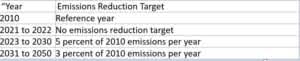
Which I (AJ) graphed here:
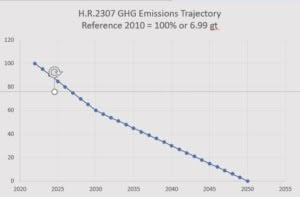
Although the graph suggests that by 2050, emissions would reach zero, the clause that decommissions the program when emissions drop to 10% of 2010 level means that the program would be decommissioned in 2047 when emissions drop from their 2046 level of 12% to 9% in 2047. Thus net zero is never achieved.
A second concern is whether the fee structure of $15 per ton raising by $10 annually is likely to achieve the trajectory and goal suggested. The answer to this question is: probably not! When the Oregon legislature was considering a carbon (greenhouse gas emissions) pricing policy in 2013, instead of passing it, they funded a study conducted by the Portland State University Northwest Economics Research Center on the economic impacts of such a plan. The subsequent report: Economic and Emissions Impacts of a Clean Air Tax or Fee in Oregon (SB306) concluded that in order to achieve the downward emissions trajectory embodies in Oregon’s 2007 (HB3543) voluntary emissions reduction target (75% below 1990 level by 2050) the fee per ton of carbon dioxide equivalent (CO2e) emissions would need to be imposed above $150 per ton.
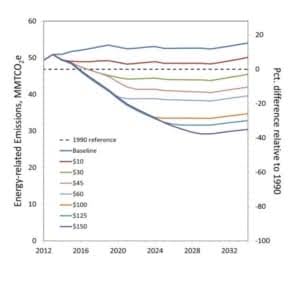
The target of 75% below the 1990 emissions of 58 Million Metric Tons (MMT) of CO2e is 14.5 MMT. As this graph indicates, even with a fee of $150 per ton, emissions drop until around 2028 and then rise again. In Oregon, even $150 is inadequate to stimulate the trajectory established in the 2007 legislation. There is no reason to think that the Oregon energy economy is sufficiently different from the rest of the nation that HR2307 fee of $15 a ton rising by $10 increment annually will remotely achieve the designated trajectory or goal.
The evidence is clear that if we hope to prevent the worst outcomes of global warming that crossing a myriad of tipping points would impose, we absolutely must restrict warming to 1.5⁰C pre-industrial conditions. The latest (2021) Intergovernmental Panel on Climate Change report (AR6) indicates clearly that to limit warming to that level, we have an emission budget from 2020 of 500 Gigatons (for a 50% chance, of 400 GT for a 66% chance and of 300 GT for an 83% chance. Our deadline for reaching net zero, then is 2030, 2028, or 2026 depending on what percentage risk we wish to bear.
While HR2037 demonstrates commitment on the part of its sponsors to address the climate crisis, it almost certainly fails to offer a trajectory that would achieve the reductions we need.
This was introduced by Bernie Sanders (I-Vt) and referred to Environment and Public Works
The proposal would require the President to declare a national emergency relating to climate change under the National Emergencies Act, and for other purposes…
- expanding access to clean and affordable energy
- modernizing and retrofitting infrastructure
- investing in public health in preparation for extreme climactic events;
- protecting and restoring natural systems
- supporting farmers and rural communities (regenerative agriculture)
- transforming the industrial base of U.S. economy with clean energy technologies, reducing industrial pollution, employing clean domestic manufacturing
- Promoting a just transition
- Reducing Greenhouse Gas (GHG) emissions
- Promoting resilience to climate change
- Supporting small businesses (especially minority and women)
- Expand public services
Senators Van Hollen (D – MD), Sanders (I -VT), Markey (D -MA), Whitehouse (D -RI, Warren (D – MA)
- $500 billion over ten years from U.S. fossil fuel corporations
- ExxonMobil, BP, Shell, and Chevron – $5 to 6 b pa = < 3% of their annual revenue
- Funds to assist those affected by climate change
SOCAN Board Endorses the Green New Deal
General Information
The Carbon Mistake A discussion of when it’s appropriate to focus discussion on carbon and when this is not appropriate and actually generates counter-productive confusion.
The Tax versus Cap Approach to limiting greenhouse gas emissions. A discussion of the cap approach versus tax approach to pricing greenhouse gas emissions, including a discussion of the ways funds can be expended.
The Natural Gas conundrum A discussion of why fossil (natural) gas is not a climate solution.
The Climate Science Consensus A discussion of the twelve step sequence comprising the climate science consensus describing the science of global warming and the climate chaos it is causing.
