
“Adapting to Climate Change: An Introduction to the Climate-Smart Conservation Approach”
Article by Charisse Sydoriak – SOCAN August 08th, 2022
Overview
- Addressing growing threats brought about or accentuated by climate change requires a fundamental shift in the practice of natural resource management (Glick et al. 2021, Schuurman et al. 2020, Stein et al. 2014). Preserving or restoring natural ecosystems to some sort of historic condition is becoming increasingly difficult due to accelerated climatic change, altered disturbance regimes, and the far reach of human influence. Using a historic target for restoration is highly unlikely to be a viable long-term strategy.
- The future climate will be the primary factor determining vegetation conditions and species viabilities in this century. Species will have to adapt in place; shift in distribution to track with evolving suitable conditions; or go extinct. The ability of humans to alter species responses will be limited.
- Management activities should be evaluated continuously to determine whether goals, objectives, and assumptions remain viable. For valued species and ecosystem services to persist, more diverse natural resources management approaches over extended timescales and geographic scope, are needed.
- Being “climate-smart” is “the intentional and deliberate consideration of climate change in natural resource management, realized through adopting forward-looking goals and explicitly linking strategies to key climate impacts and vulnerabilities” (Stein et al 2014). It entails INTENTIONALLY making a transition from a paradigm of protection and restoration (resisting change), to one that anticipates and actively manages for uncertain yet plausible future conditions. The challenge is to manage for acceptable outcomes, with uncertainty clearly in mind.
- Climate-Smart Conservation: Putting Adaptation Principles into Practice (Stein et al 2014) offers guidance for designing and carrying out natural resources management activities in the face of a rapidly changing climate.
Key characteristics of the “Climate Smart” approach are:
- Linking actions to climate impacts. Natural resources management strategies and actions are designed specifically to address the impact of climate change in concert with existing threats. Actions are supported by an explicit scientific rationale and understanding of potential climate vulnerabilities.
- Embrace forward-looking goals. Management goals focus on current and future, rather than past conditions. Strategies take a long view (decades to centuries) but account for near-term challenges and needed transition strategies.
- Consider broader landscape context. On-the-ground actions are designed in the context of broader geographic scales to account for likely shifts in species distributions, to sustain ecological processes, and to promote collaboration across land management boundaries.
- Adopt strategies robust to uncertainty. Strategies and actions ideally provide benefit across a range of possible future conditions to account for uncertainties in future climatic conditions, and in ecological and human responses to climate shifts.
- Employ agile and informed management. Natural resources managers and the public embrace experimentation, continuous learning and dynamic adjustment to accommodate uncertainty–regularly taking advantage of new knowledge to cope with rapid shifts in climatic, ecological, and socioeconomic conditions.
- Minimize carbon footprint. Adopt strategies that minimize energy use & greenhouse gas emissions and employ tactics that enable systems to naturally cycle and store carbon.
- Account for climate influence on project success. Monitor the results of actions taken. Avoid investing effort likely to be undermined by climate-related changes unless part of an intentional strategy.
- Safeguard people and nature. Adopt strategies and tactics that enhance ecosystems’ capacity to protect human communities and co-beneficial biota from climate change impacts.
- Avoid maladaptation. Avoid choosing activities that ostensibly reduce vulnerabilities to climatic change but actually have unintended adverse consequences on human or natural communities.
Climate-Smart Adaptation Process Cycle

Figure 1: Climate Smart Planning Cycle [note:
while this source graphic (Glick et al 2021) mentions forests,
the approach can be applied to other ecosystems]
Climate-Smart Adaptation Process Cycle
While there are other adaptation planning tools (i.e., Swanston et al. 2016), the National Wildlife Federation climate-smart adaptation process approach (Glick et at., 2021 and Stein et at., 2014, Figure 1) emphasizes iterative review of current and future conditions, assessing vulnerabilities, questioning assumptions, educating and engaging stakeholders, monitoring, and agility—key characteristics of the climate-smart approach. The process steps are briefly described here.
Step 1: The first step is to clearly articulate values of concern in a collaborative manner and describe why they are important ecologically and socio-economically. The purpose of the organization’s goals for a resource is often defined in law or policy, but sociopolitical concerns (i.e., equity) should be integrated in the process.
Step 2: The next step is what makes the climate-smart process unique. The values identified in step 1 are assessed for their vulnerabilities based on the best available science and global climate change modeling to determine if those values are likely to be affected positively or negatively by climatic change. All living things exist within a range of environmental conditions that are likely to shift and may be entirely lost from an area in a future climate. Climatic change vulnerability is assessed by looking at exposure potential over time, inherent sensitivity, and adaptive capacity. At a minimum, the value-of-interest is examined relative to existing stressors such as pollution, habitat loss, or invasives and its physiological vulnerability to increasing temperatures and changes in precipitation in the next decade, mid-century, or longer. This step requires expert knowledge, geospatial tools, and review of the scientific literature.
Step 3: This step requires critical reflection on the vulnerabilities developed in step 2 for a reality check. If the value is at high risk in the face of climatic change, the original goals and objectives may be unrealistic unless the value can survive somewhere else. When this occurs, the goals and objectives should be critically evaluated and intentionally revised.
Step 4: In step 4, a suite of adaptation options or “strategies” are identified based on the vulnerability assessments (step 2), and on management feasibility and cost (step 3). Step 4 entails looking at a range of plausible future conditions (i.e., scenario planning) to find places where valued resources could persist with or without management intervention; and intentionally deciding where, why, and how to take action to protect values-at-risk. A tool called the Resist-Accept-Direct (RAD) decision framework which “captures the entire decision space for responding to ecosystems facing the potential for rapid, irreversible ecological change” is introduced below to facilitate development and implementation of realistic (climate-smart) management strategies across space and time.
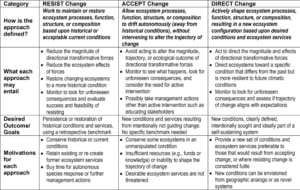
Climate-Smart Approaches/Strategies: Making climate-smart decisions in the face of uncertain future conditions can be overwhelming. Fortunately, the Resist-Accept-Direct (RAD) Framework (Schuurman et al. 2020) narrows the decision space to only three choices (Table 1). Common to all is a commitment to “intentionally intervene to shape the trajectory of ecosystem change” based on “underlying goals and values, and motivations for taking each approach.” All three approaches are warranted simultaneously depending on acceptable outcomes and where, when, and why management action is being considered.
Table 1. Resist-Accept-Direct (RAD) approaches (modified from Schuurman et al. 2020)
Step 5: An action plan is produced and implemented in step 5 based on a suite of selected strategies and experimental approaches. To support the plan, stakeholders need to be educated starting with the original goals and objectives (step 1) and walked through the findings in steps 2-4 to show why, where, when, and how goals and objectives can or cannot be attained based on the best available science, plausible future condition forecasts, time constraints, and available resources (i.e., costs). The plan should intentionally incorporate the nine key characteristics of the climate-smart approach (listed above), identify assumptions made, and provide the means for evaluating success based on climate sensitive metrics. In addition to articulating the strategic framework (step 4), the action plan should prescribe implementation tactics and projects. The “Adaptation Workbook” (Swanston et al. 2016) provides a “menu of adaptation strategies and approaches” to facilitate project level action planning and implementation in forest ecosystems.
Steps 6: During implementation it is likely that adjustments will be needed. This means that metrics need to be identified in the plan (step 5), regularly monitored, and an administrative structure set up to be responsive to unforeseen situations. The plan implementors should take the long view and be humble, nimble, and responsive when things don’t go as planned. When conditions warrant, the planning process should be reinitiated to validate and correct original assumptions and planned actions.